 Lazy ASO
The ultimate ASO guide, based on 350,000 App Store results in 87 countries
Updated 8 November 2026
We looked at 350,000 App Store results for the most popular searches in 87 countries. A new app whose name starts with the search is 2 to 3 times more likely to reach the top 10 than one without the search in its name. "Brand: search" after a colon does about as much as no search at all. With up to two rivals on the name, the chance is at least 3 times higher than with five or more.
You built an app. You shipped it. 10 downloads
I've been there, with more than one app
So I stopped reading ASO advice and measured everything
You think it all comes down to luck. I'll prove it doesn't
Here's an example. US App Store, the search "sky map":
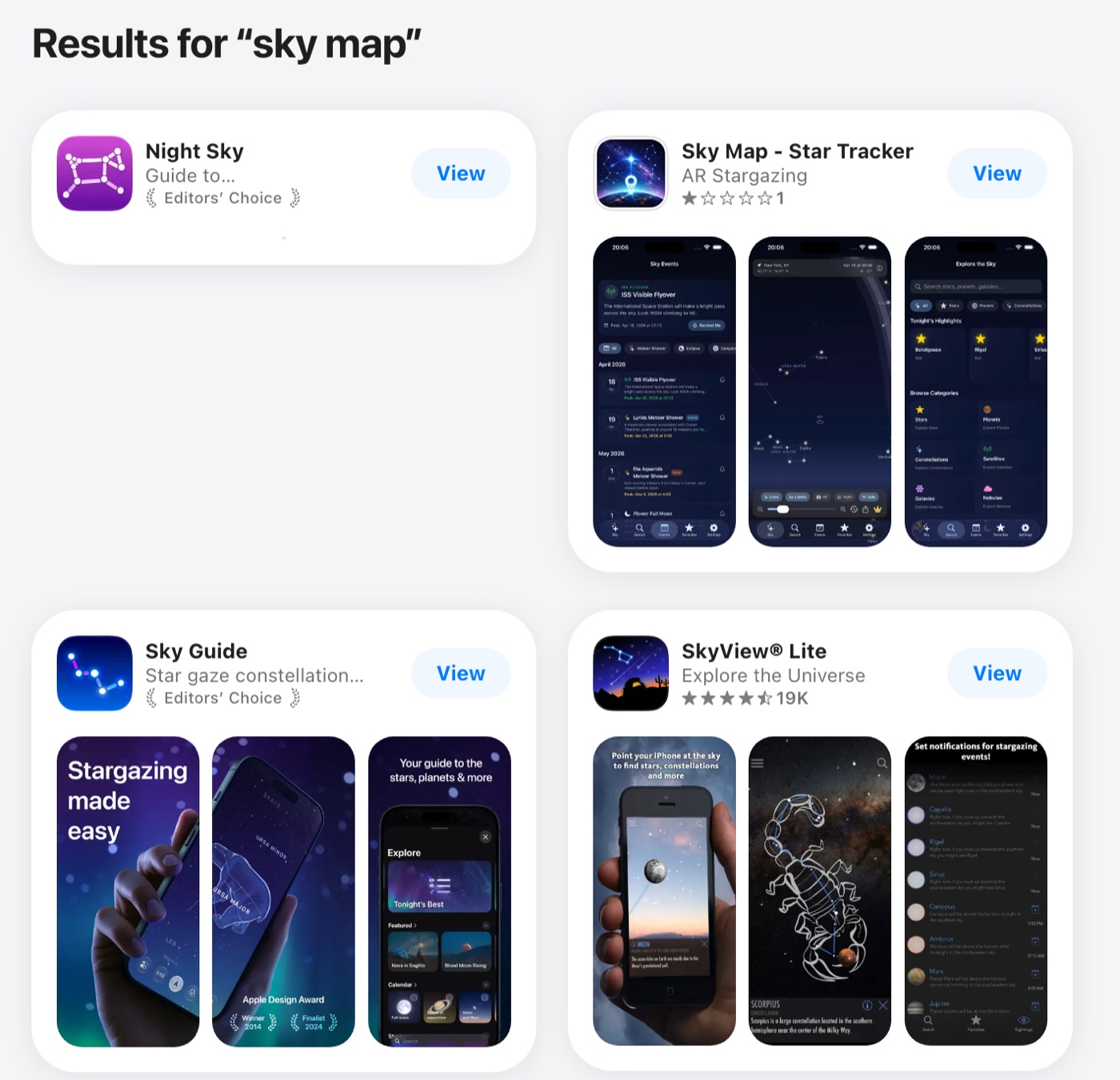
An app with a single 1-star rating beat a giant with 19k ratings, in the most competitive market
That's rare, but it's not luck. By the end of this guide you'll know what it depends on and how to raise your app's odds
How I know this. I took Apple's official lists of the most popular searches, up to 500 per country and category, in 87 countries. For each search I pulled the results, about 350,000 in total. Then I looked at every new app in those results, released in the last 6 months
About 42k of them made a top 10 somewhere. 67% have fewer than 10 ratings
Then I looked at what helped them get there. But let's go in order, starting with the simplest part
1. The fields the App Store reads
Your listing has four places for text, and they work differently
Name. 30 characters. The strongest place you have
Subtitle. 30 characters. It moves your position less, but it can still help you reach the top
Keyword field. 100 characters. Nobody sees it, but it counts: its words combine into searches with each other, with the subtitle and with the name
Description. It doesn't affect your App Store position, so stop stuffing it with keywords. But ChatGPT reads it, and that matters more than you'd think. More in section 5
The name is the strongest place. So let's start there
2. Put the keyword first in your name
Most people put their beautiful brand first
I get it. You spent days on that name. But nobody searches for it yet
Here's the chance of a new app with under 100 ratings reaching the top 10
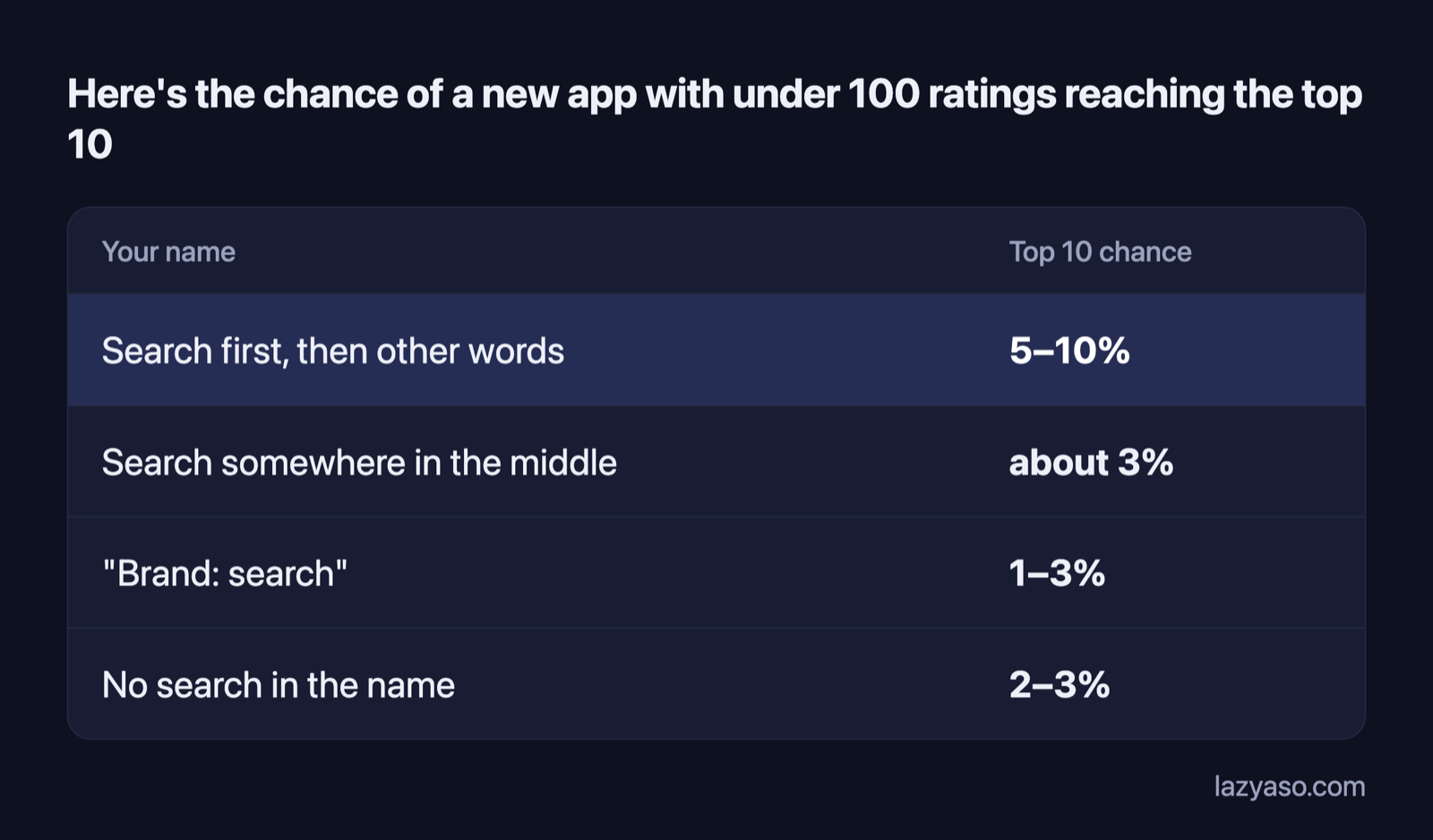
Look at "Brand: search"
It's about the same as leaving the keyword out
So write this:
Sky Map - Star Tracker
Not this:
Stellar: Sky Map
A word after the colon gets you into the results. It won't lift you to the top. I checked it on 4.9M other position observations: search first, median #5. Search inside the name, #11. No search in the name, #11
An exact name works even better, but it ties you to one search. The winners I saw use search + difference: Calorie Counter by Numify, Sleep Tracker by Remly
3. Pick a keyword with a free name and real demand
Now you know the search goes first. The question left is which search to take. This is the main thing in this guide
The ideal case: take a search with real demand and a free name. That's when your chance of reaching the top is high
Here's what lifts a new app into the top 10
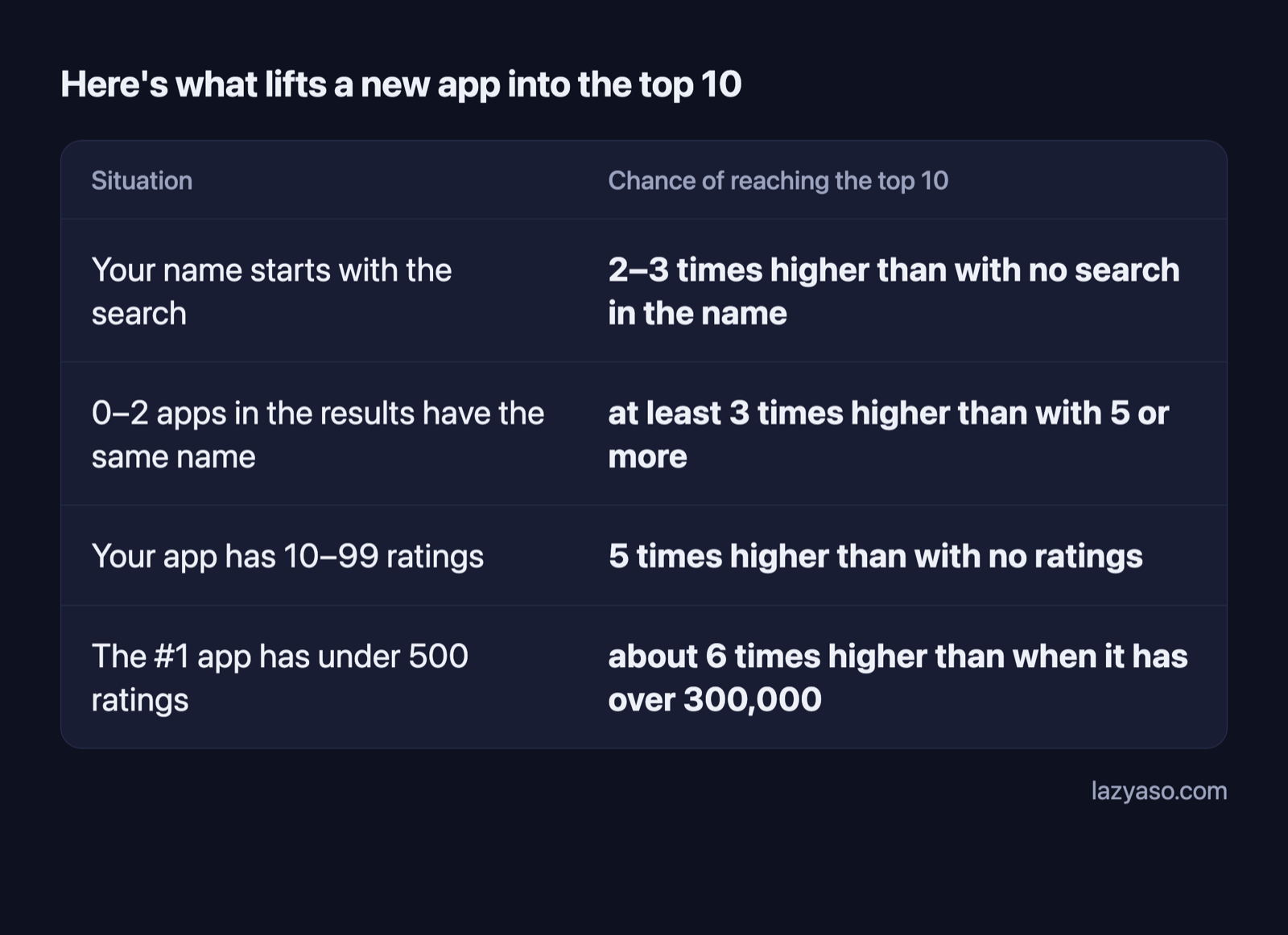
Competition matters as much as the name. The more apps start their name with your search and the stronger the leader, the lower your chance. But a giant doesn't shut you out: with few rivals on the name, about 5% of new apps make the top 10 even when the leader has over 300,000 ratings
And check that people actually search your name. Don't go by the popularity number in Apple Search Ads: everything below 5 looks the same there, and real searches hide under that number. Use Apple's official list instead: up to 500 of the most popular searches per country and category, the Search Term Popularity report in the Apple Ads Platform API. That's where the searches in this guide come from. If a search isn't on the list, it just didn't make the top 500. That doesn't mean nobody types it
Want to check your name right now? I made a free tool for it, on the home page
4. Use your subtitle and 100 keyword characters
That's the name, but your listing has two more fields. Each field should carry different real searches. First list the searches in your niche and check demand and competition for each. The rest is simple
In the name, put the search halfway between demand and competition. The most popular one usually has rivals that are too strong. An empty one nobody types is no use either
The subtitle and keyword field get the rest. The stronger ones go in the subtitle. The weaker ones go in the keyword field
Just don't expect much from the keyword field. It wins small results and won't carry you through big ones
A few rules worth knowing:
- Don't repeat words across fields. It wastes characters
- Apple builds phrases from separate words, but it won't join them into one. If people search it as one word, put that whole word in
- Different forms of a word can count as different words. Use the form people type
5. Write your description for ChatGPT
Keywords are done. One text is left, the description. It doesn't affect App Store search, but it works somewhere else
ChatGPT recommends apps based on their App Store description, and having few ratings didn't stop my app. That surprised me the most
ChatGPT gave my Bible app 351 impressions and 256 downloads, a 73% conversion. App Store search on the same app gives 5%. That's one app, so test it on yours
So try rewriting your description:
- First lines: what the app is and who it's for
- Your unique features, in concrete words
- Think about what people will ask ChatGPT, and what your description needs to say so it recommends you and not a competitor
6. Screenshots won't lift you in search, but they sell
That's it for text. Now the part people see
Many people add screenshots and ship weekly updates to climb in search. It barely affects your position
Here's how many new apps reached the top 3:
- with 3–4 screenshots 12%, with 9 or more 8%
- updated under 2 weeks ago 9.4%, over 4 months ago 10.5%
- released a month ago 9.5%, six months ago 11%
Screenshots do a different job: they convince the person who found you to download. Put your effort into the first three, because they show right in search, and improve conversion with A/B tests
7. Get your first 10 ratings
Screenshots barely affect your position, but ratings do. The more ratings a new app has, the better its chance:
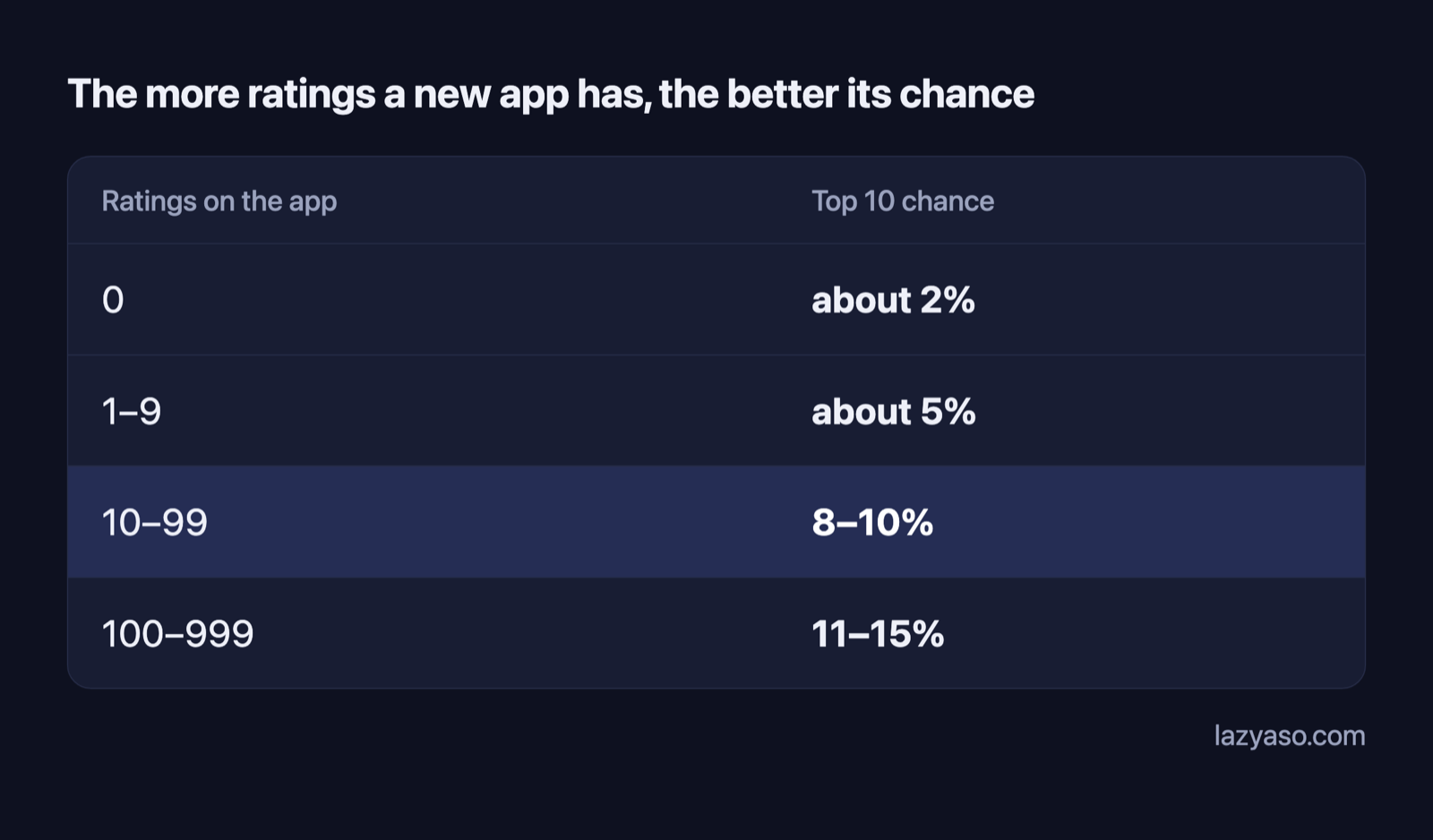
With 10 ratings your chance is almost twice what it is with 1–9, though part of this runs backwards: a high position brings ratings by itself
If you have no ratings yet, the name decides, so start there. If you already have some, look for a free name or results where the apps have few ratings
And expect ratings to come slowly, and separately in each country. In my Quran Widget about 1,600 prompts gave about 21 ratings, that's 1.3%
8. Localize how people search
All of this was about one country so far. But there are many
Of course everyone wants the US top. But there are countries with demand for your app and far less competition
Don't translate your listing word by word. People search differently from country to country, because of language and culture. The direct translation of your name may be something almost nobody there types
So in each country, look for keywords again: what do people type in your field, including related searches. Then run sections 2 to 4 for those
9. Track the results
Here's the sobering part
84% of new apps named with a search sit below #25
A free name is not a guarantee of success. It's a bet with good odds, and you can place it in 87 countries
So track your positions and installs, and experiment with new keywords and combinations
10. ASO won't save a weak app
Even a great position isn't everything
ASO gets you installs. It doesn't guarantee that people stay or that you make money
It's only the first part. The rest depends on the app: what value it gives people, how good your onboarding is, and whether people buy your subscription. That's not about ASO anymore
One important thing: all of this works for a new app, when you want to compete on the App Store without huge marketing investment. If you're already strong at marketing, with UGC and your own audience, the bet is different: a brand is easier to promote, because people remember it
One last thing
If you take one thing from this guide, make it this: find a search people type that almost nobody starts their name with, and put it first in your name
Sounds simple. But even with AI, collecting the data takes weeks
I already did all of it for you
Lazy ASO is a Mac app with everything from this guide inside: Apple's official demand in 87 countries, up to 500 searches per category in each, 350,000 results pages, and the top 10 chance for every keyword
Connect your AI in one click, and it finds searches with a free name in every country and writes your name, subtitle, keywords and description. You say yes, and it's all in App Store Connect
Stop guessing. Know your real odds and place the right bets with Lazy ASO